Hello, Physical World: The Evolution from Bare Metal to AIoT
Friday, August 28, 2026
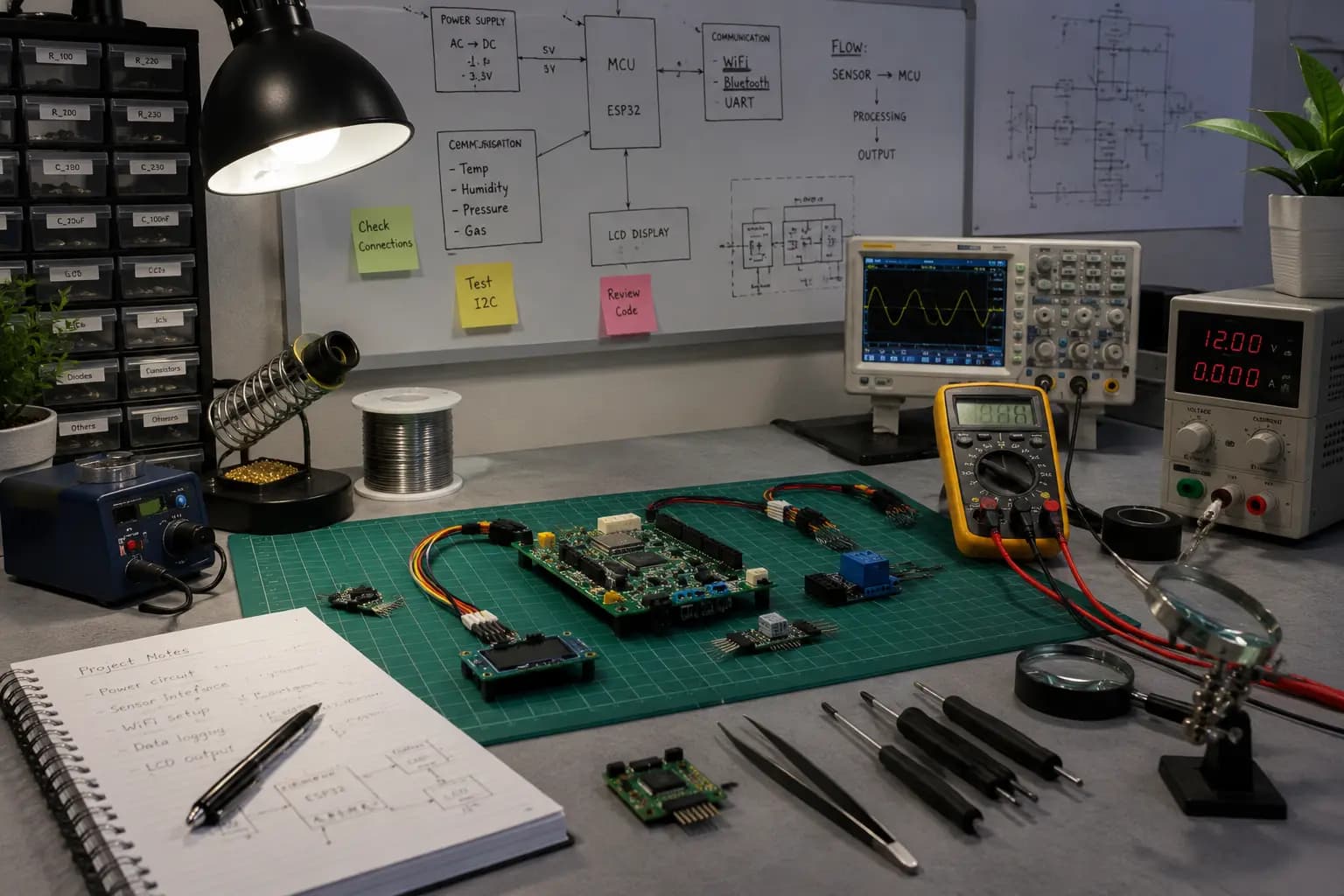
Welcome to my corner of the web. This is a space dedicated to the intersection of software and the physical world: Embedded Systems, the Internet of Things (IoT), and the frontier of AIoT (Artificial Intelligence of Things).
Whether you are here to learn, collaborate, or just watch me troubleshoot a fried microcontroller, here is a roadmap of what this blog is all about.
The Foundation: Bare Metal and Silicon
Everything starts at the hardware level. Before a device can be "smart," it has to exist.
This space will dive deep into the trenches of embedded systems. We're talking about the lifeblood of hardware—writing efficient C code to manipulate registers, read sensor data, and control actuators. It’s about taking a raw microcontroller, like an ESP32 or an STM32, and building a system around it from scratch.
We don't just write software; we build its home. Expect deep dives into designing schematics, routing 0805 SMD components on two-layer boards, generating Gerber files, and firing up the 3D printer to fabricate the perfect custom enclosure.
The Awakening: The Internet of Things (IoT)
A beautifully designed circuit is great, but an isolated system is limited. IoT is where our hardware gets a voice.
We'll explore what happens when you take that custom sensor node and connect it to the world. How do we securely transmit environmental data over Wi-Fi? How do we build web dashboards that let us control heavy loads from across the globe? It’s the bridge between a physical breadboard and a full-stack digital experience.
The Brain: AIoT and Edge Intelligence
This is where the industry is moving, and where things get truly legendary.
For a long time, microcontrollers were just data gatherers. They collected information from sensors and sent it to a massive cloud server to do the actual "thinking." Not anymore.
Enter TinyML and Edge AI.
What if your microcontroller didn't just read a gas sensor, but actually ran a local neural network to evaluate food freshness? What if a smart attendance system could process biometric data directly on the device, with zero latency and no reliance on the cloud?
AIoT is about bringing the brain directly to the edge. We'll explore how to train lightweight machine learning models, convert them into C-arrays, and flash them onto microcontrollers. It is the ultimate synthesis of hardware engineering and artificial intelligence.
What's Next?
Building these systems isn't a clean, linear path. It involves burnt out components, late-night debugging sessions, and a lot of trial and error.
This blog will be a living document of that process. I’ll be sharing project teardowns, code snippets, hardware design rules, and the brutal lessons learned from building things that interact with the real world.